
As many have said in different ways, there’s an element in current Alaska fiscal policy that makes it bound to fail: the most politically influential Alaskans, including Alaska’s legislators, don’t have to pay for the costs of government. To them, it is a “free good,” almost entirely paid for by others.
As with any free good, the consequence is simple. There is no economic constraint on the most politically influential Alaskans continually supporting, indeed pushing – or in the case of legislators, continually proposing and voting for – more of it.
To a degree, it’s a characteristic that Alaska shares in common with the federal government. There, by issuing Treasury bonds, Congress can shift a large share of government costs onto the backs of future generations. While many complain about current federal tax “burdens,” the truth is that taxes and other revenue sources cover only about three-quarters of the federal government’s costs. The remainder is covered through debt to be paid by future generations.
Throughout most of the 2010s, Alaska used a similar approach. While it didn’t issue debt, a large share of annual budgets during that period was financed first by draws on the Statutory Budget Reserve (SBR) until it was depleted, then by similar draws on the Constitutional Budget Reserve (CBR) until the CBR was largely depleted as well.
The CBR, in particular, has always been intended to be a temporary source of financing for state government during periods of fiscal instability, to be replenished once those periods are over for similar use by future generations when they experience their own periods of fiscal instability. By draining the CBR and not refilling it, this generation of Alaskans has pushed the costs of future fiscal instability, intended to be softened for each generation by the CBR, entirely to future generations.
Put another way, this generation of Alaskans is leaving the fiscal cupboard bare for future generations of Alaskans when they experience their own periods of fiscal instability. It’s the same destination, by a different path, as when the federal government leaves unpaid debt at the doorstep of future generations of Americans.
Through the middle part of the 2010s, we thought the point at which the CBR was drained would be a turning point. With no more “free money” to be taken from future generations, the Legislature would reluctantly turn to broad-based taxes as the marginal source of revenue, creating pushback from those being taxed, including the most politically influential Alaskans, against continued spending growth.
But that didn’t happen. Instead, when it reached that point, the then-Legislature started withholding and diverting (i.e., taxing) a portion of the Permanent Fund Dividends (PFD) due under current law to Alaska families, directing that portion to the general fund to cover the ongoing deficits that had previously been covered through the SBR and CBR draws.
As Professor Matthew Berman of the University of Alaska – Anchorage Institute of Social and Economic Research (ISER) has explained, “a cut in the PFD is … the most regressive tax ever proposed.” A regressive tax takes a larger percentage of income from low-income earners than from high-income earners. As “the most regressive tax ever proposed,” PFD cuts push the impact to extremes. As we’ve explained in previous columns, while PFD cuts have a trivial impact on upper-income Alaska families, they have an increasingly severe effect on middle- and lower-income Alaska families.
Because the most politically influential Alaskans, including legislators, are largely, if not entirely, in the upper-income brackets, using PFD cuts to fund government has had the same negligible impact on spending levels as did relying on the SBR and CBR. Because government remains a “free good” for the politically influential, they offer limited resistance when various interest groups and other constituencies push for ever more government spending.
The general attitude seems to be: “Who cares. We aren’t paying for it anyway.”
Some argue that all that’s needed to rebalance state fiscal policy is a “spending cap.” They believe that an artificial line drawn across future years, based on past spending levels and adjusted for inflation and, perhaps, population “growth,” will bring discipline to the state’s fiscal process.
But that ignores virtually the entire history of economics, which teaches that incentives, not artificial lines, regulate behavior. Without the incentive of being required to pay for a portion of the increases themselves, the most politically influential Alaskans will find ways around the artificial line created by a spending cap if they adopt it in the first place.
Moreover, as the following chart demonstrates, spending caps alone don’t work in an environment where revenues fail to grow at the same level.
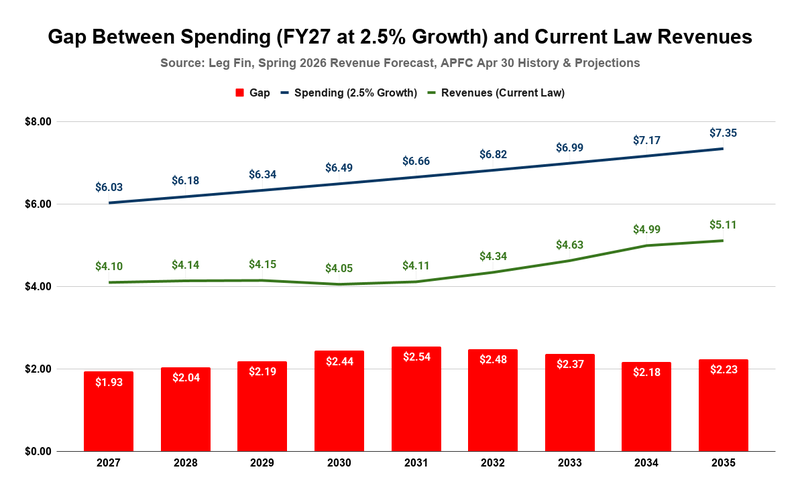
This chart traces projected spending and revenue levels over the next decade. The spending levels are calculated using the enrolled Fiscal Year (FY) 2027 unrestricted general fund (UGF) budget as the baseline, “capped” thereafter at inflation (projected to be 2.5%). Revenue levels are the sum of the “traditional” revenue levels projected in the Spring 2026 Revenue Forecast, plus the portion of the annual percent of market value (POMV) draw from the Permanent Fund statutorily designated for the general fund, calculated from the projections made in the Alaska Permanent Fund Corporation’s most recent “History and Projections” Report.
As is clear, the spending cap doesn’t have the effect some anticipate. Because of stagnant-to-declining revenues, annual deficits actually grow through FY2031, even with a spending cap. While deficits are projected to fall thereafter from that mid-period high, they still end the period at a higher level than they began in FY2027. A spending cap alone is wholly ineffective at reducing the state’s deficits.
Others think that the solution is “starving the beast” of government by enacting no new revenues. But as the past several years of “no new revenues” have demonstrated, that approach doesn’t eliminate or even reduce deficits. It just results in ever-deepening levels of PFD cuts, “the most regressive tax ever proposed,” to cover the ever-deepening deficit levels.
Some think that continuing to use PFD cuts to cover the deficits is acceptable fiscal policy because, in their view, PFDs are “free money” and reductions in them are just less “free money.”
But as we have explained in previous columns, using PFD cuts doesn’t make the “free money” disappear; it simply shifts over to subsidizing even more “free government” for upper-income Alaskans. Some attempt to rationalize the result by asserting that a portion of the money is used to implement programs that provide a hand up to lower-income Alaska families.
In other states, however, such programs are funded by broad-based taxes so that upper-income families contribute a share of the hand-up costs as well. Here, by using PFD cuts to fund them, all that is happening is that middle and lower-income Alaska families are being taxed increasingly heavily to fund programs designed to benefit a subset of the same group.
Rather than a “hand up,” what is occurring with such programs is that middle- and lower-income Alaska families are being compelled to “hand over” the funding through PFD cuts. At the same time, upper-income Alaskans avoid any significant financial responsibility. They can claim to have done a “good deed,” but dodge paying any share of the costs. Instead, they have put the costs squarely on the backs of the very people they are claiming to help.
Moreover, far from all of the spending benefits lower-income Alaska families. Most also benefit upper-income families, directly or indirectly. But by using PFD cuts to fund it, they dodge any significant financial responsibility, even for the share that benefits them.
The result is a fiscal version of “heads I win” – if it’s targeted primarily for lower-income Alaska families, I don’t have to pay for it – “tails you lose” – if it benefits upper-income Alaska families, I still don’t have to pay for it because, by using PFD cuts, the burden is shifted almost entirely to middle and lower-income households.
By avoiding significant financial responsibility for any of it, upper-income Alaskans, including legislators, have no incentive to limit it. Indeed, because a substantial portion of the spending also benefits them and they accrue political credit with various constituencies, even for the portion that doesn’t, there is an incentive to spend even more.
What is the solution? The 2021 Legislature’s Fiscal Policy Working Group (FPWG) Report accurately captured it. Enact a comprehensive approach that addresses all of the aspects of the problem at the same time, including broad-based taxes that simultaneously both spread the fiscal burden currently concentrated on middle and lower-income Alaska families broadly, to include material contributions from non-residents, and create a significant incentive for upper-income Alaskans, including legislators, to push back on unsupported spending.
Unfortunately, there are signs that the near-term outlook for its adoption remains slim. For example, while two of the signatories to the 2021 FPWG Report are currently running for Governor (former Representative Jonathan Kreiss-Tomkins and former Senator Shelley Hughes), neither is promoting the Report as part of their current campaign.
But that doesn’t mean the steps outlined in the Report aren’t the solution. It simply means that Alaska is likely to remain stuck in its failed fiscal approach even longer. And as it does, the hole that will eventually need to be filled will become ever deeper.
Brad Keithley is the Managing Director of Alaskans for Sustainable Budgets, a project focused on developing and advocating for economically robust and durable state fiscal policies. You can follow the work of the project on its website, at @AK4SB on Twitter, on its Facebook page or by subscribing to its weekly podcast on Substack.